

In recent years, electronic skin, as an emerging flexible sensor device, has important application value in fields such as healthcare, tactile feedback, and robotic perception. Especially in robotic tactile perception, electronic skin can not only build a human-machine-object interaction bridge but also endow robots with richer tactile information perception capabilities. However, existing electronic skins mostly suffer from problems such as single force-sensing characteristics, fixed conductive states, and passive response mechanisms, making it difficult to simulate the active tactile perception and self-feedback regulation of human skin in complex dynamic scenarios and to simultaneously achieve high sensitivity, a wide measurement range, and environmental adaptability. How to realize “adaptive perception” in the field of robotic touch—allowing sensors to dynamically adjust their performance according to changes in the external environment—has long been a difficult problem that scientists have been striving to overcome.
Recently, the research team led by Professor Wei Dapeng at the Chongqing Institute of Green and Intelligent Technology, Chinese Academy of Sciences, inspired by the human tactile neural network, successfully developed a flexible electronic skin based on a biomimetic adaptive mechanism. They published a research paper entitled "Self-adaptive magnetically force-sensitive electronic skin based on biomimetic conductive network structure" in the journal Nano Research, and the work was successfully selected as a cover article for the December 2026 issue, Vol. 19, No. 12.
This study developed an adaptive force-sensitive electronic skin based on a biomimetic "island-bridge" topological conductive network. In the device, NdFeB magnetic microparticles that form ordered chains under a magnetic field serve as "islands", while surface-loaded multi-walled carbon nanotubes form conductive active "bridges" through the electron tunneling effect, mimicking neural synapses to achieve dynamic network reconfiguration under electromagnetic coupling and magnetic-field regulation of force-sensing performance. Its internal hierarchical pyramidal microstructures can concentrate stress under external force and shorten the spacing between conductive pathways. Together with a 5-nm-thick HfO2 tunneling barrier layer, it suppresses intrinsic interface noise and improves the signal-to-noise ratio by about 14 s, enabling the sensor to achieve dynamic performance optimization over an ultra-wide pressure range from 1 Pa to 3.5 MPa. The low-pressure sensitivity can reach 235.6 kPa-1, the signal-to-noise ratio in the medium-pressure region is 89 dB, and the sensor simultaneously has a fast response of 10 ms and stability over more than 10,000 cycles.
The research team integrated this electronic skin into the soles of a Xiaomi CyberDog robot dog. With a self-developed PCB acquisition circuit and host-computer software, they collected plantar pressure signals during walking at 0.3 m/s. Using an LSTM temporal neural network, they trained and recognized a total of 5,000 sample sets under five terrains—mud, sand, grass, rubber, and tile—and five magnetic field conditions, achieving a maximum terrain recognition accuracy of 99.21%. The system could also distinguish subtle differences within the same terrain, such as dense versus sparse grass. The t-SNE dimensionality reduction results also confirmed the adaptive tactile rule that soft ground is suitable for low-magnetic-field sensing and hard ground is suitable for high-magnetic-field sensing, providing a new solution for intelligent tactile perception in legged robots.
Zhang Bingxue, a student trained by the Chongqing Institute of Green and Intelligent Technology, Chinese Academy of Sciences, is the first author of the paper, and Professor Wei Dapeng is the corresponding author. This study provides a new paradigm for robotic tactile intelligence, enabling electronic skin to be no longer merely a passive force-sensitive component but an intelligent system capable of actively adjusting its sensing strategy according to the external environment. It is expected to play an important role in scenarios such as complex terrain exploration, disaster rescue, and human–machine interaction. This research was supported by projects from the Chongqing Science and Technology Bureau, the Shenzhen Science and Technology Program, the Chongqing Municipal Economic and Information Technology Commission, the National Natural Science Foundation of China, and other projects.
Links to related papers: https://doi.org/10.26599/NR.2026.94908965
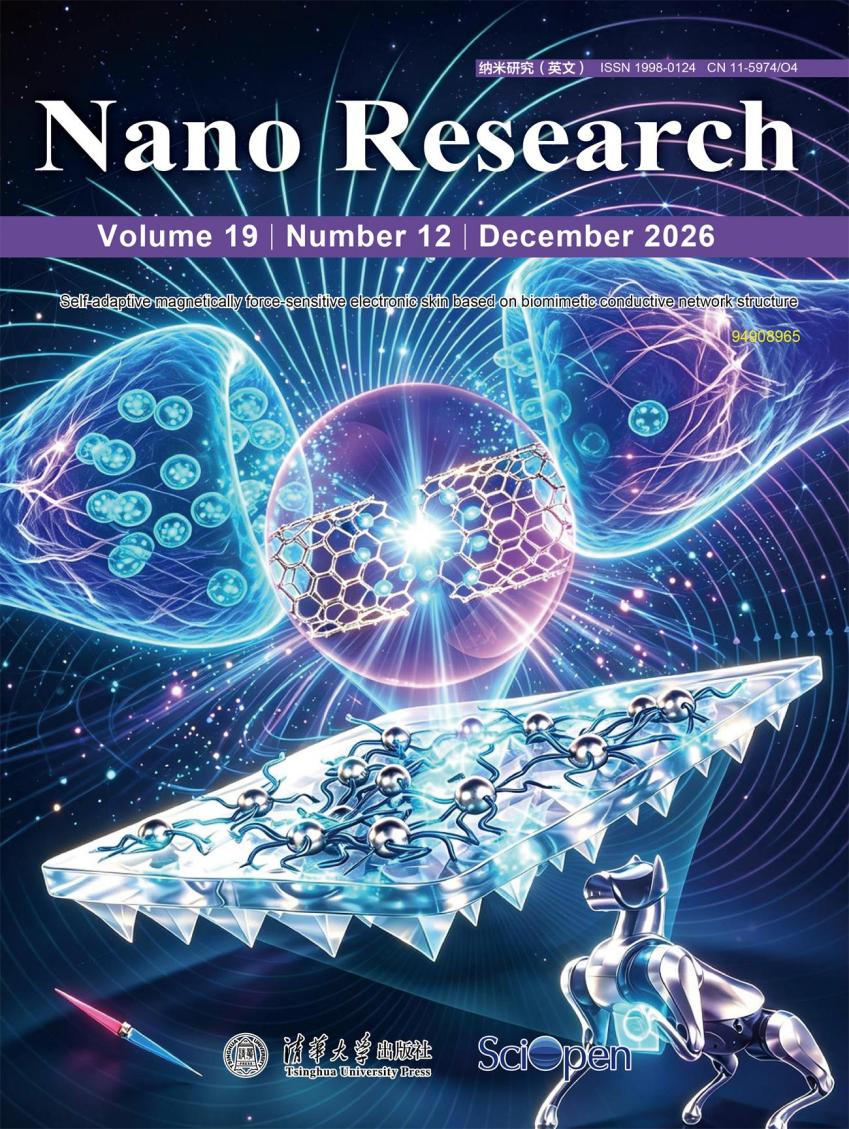
Bionic Adaptive E-skin System